

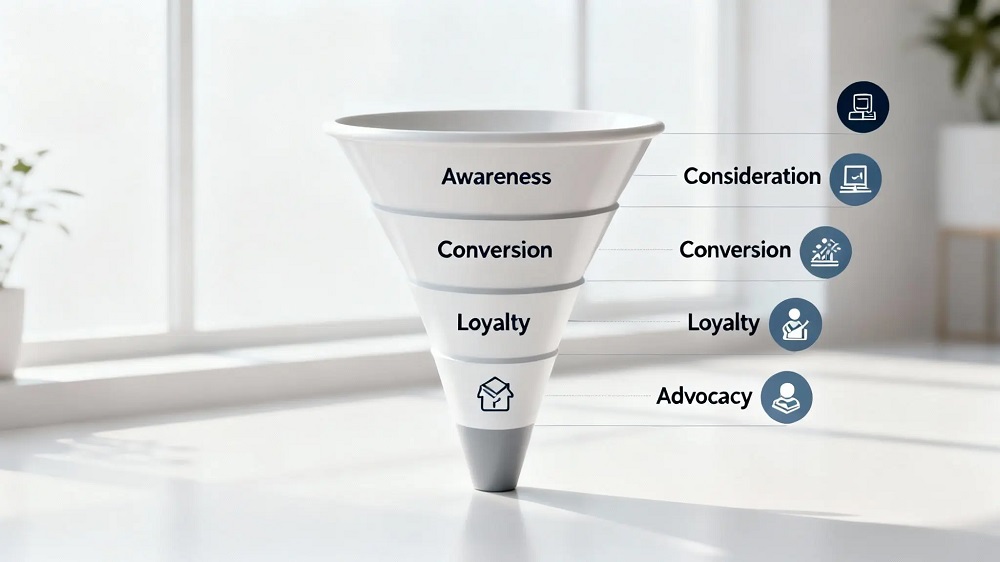
Modern consumer decision-making rarely happens in an instant. In an era saturated with endless digital advertisements, competing product options, and instant access to global reviews, buyers do not simply stumble upon a brand and immediately commit their hard-earned dollars. Instead, the path from first discovering a company to becoming a devoted brand advocate is a progressive psychological journey.
To navigate and optimize this path, businesses rely on a foundational strategic framework: the marketing funnel. While early retail concepts treated the funnel as a blunt, linear tool designed purely to push prospects toward an initial checkout, contemporary commerce demands a much more holistic architecture. An effective marketing funnel acts as a structured communication system that introduces a brand, nurtures trust, removes purchasing friction, and actively fosters repeat business. By aligning specific content, value propositions, and relationship-building mechanisms with each stage of the buyer journey, organizations transform detached strangers into loyal advocates.
The Top of the Funnel: Sparking Awareness and Discovery
The top of the funnel represents the broadest segment of the audience. At this entry stage, prospective buyers are generally problem-aware or passively curious, but they know very little about your specific brand or product offerings. The objective here is not to close an aggressive sale; pushing a direct pitch too early alienates visitors before trust can take root.
Instead, the primary goal is attracting attention, establishing relevance, and offering immediate utility that helps the prospect understand or frame their challenges.
Content Strategies for Organic and Paid Discovery
Educational and entertaining assets serve as the welcoming front porch of your digital presence:
- Informative Blog Posts and Guides: In-depth, search-optimized articles that answer fundamental industry questions, break down emerging challenges, and offer actionable advice without demanding immediate transactions.
- Short-Form Video and Visual Storytelling: Engaging video snippets across social feeds that demonstrate visual problem-solving, highlight interesting behind-the-scenes processes, or articulate common industry pain points.
- Targeted Paid Advertising: Broad-reach search and social campaigns tailored around specific problem phrases rather than brand names, ensuring your solution appears at the precise moment a user initiates an exploratory search.
- Podcasts and Digital Events: Hosting or appearing as a guest on topical discussions where company leaders share domain expertise, elevating the brand authority within relevant professional or hobbyist circles.
Capturing Early Engagement
Attracting impressions is meaningless if an organization cannot capture a bridge to future communication:
- Low-Friction Lead Magnets: Providing valuable resources like downloadable templates, concise research summaries, or interactive checklists in exchange for a simple email address.
- Pixel and Audience Tagging: Building remarketing audiences based on video views, specific page visits, or social interactions, allowing the business to deliver nuanced follow-up messaging as prospects browse other web properties.
The Middle of the Funnel: Cultivating Consideration and Evaluation
Once prospects acknowledge their need and recognize your brand name, they transition into the middle of the funnel. This phase is characterized by critical evaluation. The consumer is actively exploring potential solutions, comparing competing options, checking pricing tiers, and evaluating risk.
At this stage, marketing must shift away from broad generalizations toward deep credibility, technical competence, and differentiation. The core task is showing why your approach resolves the problem more effectively, safely, or pleasantly than any available alternative.
Addressing Objections and Building Proof
Middle-of-funnel prospects need reassurance and clear distinctions to overcome natural skepticism:
- Detailed Case Studies: Real-world examples highlighting the starting friction an existing customer faced, the specific steps taken to deploy your solution, and the measurable results achieved.
- Side-by-Side Comparison Matrices: Objective product breakdowns that directly compare your features, warranties, service terms, and pricing philosophies against traditional competitors or status-quo workarounds.
- Interactive Webinars and Product Demos: Live or on-demand walk-throughs that give prospective buyers an authentic look at the product interface, build quality, or service methodology in action.
- Automated Nurture Email Sequences: Thoughtfully timed email series that unpack common hesitations, explain product design philosophies, and share customer success stories tailored to the specific lead magnet the user originally downloaded.
Establishing Emotional and Cultural Alignment
Modern consumers frequently buy based on shared values and perceived identity:
- Transparent Founder Narratives: Sharing the authentic origins of why the company was created, what structural industry frustrations prompted its founding, and what core principles govern its operations.
- Ethical and Environmental Standards: Highlighting supply chain integrity, sustainable materials, or community reinvestment models, giving conscious buyers an emotional incentive to support your organization over generic competitors.
The Bottom of the Funnel: Driving Conversion and Decision
At the bottom of the funnel, the prospective customer has finalized their evaluation and stands on the precipice of a decision. They understand their problem, trust your competence, and prefer your offering over alternatives. However, conversion hesitation often lingers due to purchasing friction, fear of buyer remorse, or routine procrastination.
The focus here is reducing transactional barriers, clarifying terms, and providing the final psychological reassurance necessary to complete the checkout or sign the contract.
Eliminating Purchase Friction
Streamlined checkout operations prevent costly last-second abandonment:
- Risk Reversals and Guarantees: Clear, prominent money-back guarantees, free trial periods, flexible cancellation terms, and transparent warranties that absorb personal financial risk from the buyer.
- Social Proof at the Point of Purchase: Placing verified customer star ratings, authoritative media mentions, and trust seals directly adjacent to checkout buttons or pricing agreement fields.
- Tailored Consultations and Live Chat: Providing immediate access to responsive customer service agents or technical specialists who can answer final edge-case questions via real-time web messaging.
- Transparent Pricing Models: Eliminating hidden handling fees, sudden shipping surcharges, or unexpected contractual riders that disrupt buyer trust during the final checkout screen.
The Expansion Loop: Securing Post-Purchase Retention and Loyalty
Traditional marketing playbooks often ended their analysis at the purchase step, celebrating the closed sale as the ultimate destination. Modern high-growth enterprises recognize that the initial transaction is merely the beginning of the most profitable phase of the customer relationship.
Acquiring an entirely new customer requires substantial advertising and labor costs. Retaining an existing client, cultivating repeat orders, and unlocking brand advocacy drives compounding revenue with minimal acquisition overhead.
Perfecting the Post-Purchase Onboarding Experience
The immediate hours following a purchase dictate whether a buyer experiences excitement or anxiety:
- Proactive Confirmation and Tracking: Clear, immediate transactional receipts followed by transparent shipping status alerts or digital software activation guides that keep the user informed.
- Guided Onboarding Sequences: Welcoming email guides, unboxing video links, or dedicated account kickoff calls that walk the client step-by-step through achieving their first quick win with the product.
- Responsive Early-Stage Support: Checking in via automated surveys or personal messages within the first two weeks of use to catch any configuration frustrations before they turn into bitter support tickets or returns.
Cultivating Repeat Transactions and Long-Term Value
Moving a one-time purchaser into a recurring customer requires ongoing value delivery rather than constant promotional badgering:
- Personalized Product Recommendations: Suggesting refills, complementary accessories, or advanced service modules that genuinely enhance the utility of the original purchase based on actual usage patterns.
- Predictive Replenishment Reminders: Sending thoughtful reminders right as consumable goods are mathematically expected to run low, saving the customer time while capturing predictable repeat orders.
- Exclusive VIP Access and Loyalty Programs: Rewarding consistent patrons with tiered discounts, early access to new seasonal product drops, or invitations to private community events that reinforce their preferred status.
Turning Brand Loyalty Into Organic Advocacy
The true pinnacle of a high-performing marketing funnel is the transformation of loyal buyers into active advocates. When satisfied customers organically market your products to their colleagues, families, and digital followers, the funnel transitions from an open-ended pipe into a self-sustaining growth loop.
- Structured Referral Programs: Rewarding both the advocate and the new recipient with tangible incentives, such as account credits, gift cards, or exclusive gifts, removing hesitation to make word-of-mouth recommendations.
- Amplifying User-Generated Content: Resharing organic social posts, photographs, and video reviews created by passionate customers across official brand feeds, celebrating real-world users while providing authentic social validation to prospects entering the top of the funnel.
- Brand Community Ecosystems: Creating exclusive digital forums, user groups, or localized meetup clubs where passionate customers can share creative use cases, discuss industry strategies, and build relationships anchored around your brand.
A modern marketing funnel is not a manipulative conveyor belt designed to force individuals into spending money; it is an organized framework for establishing and maintaining human relationships at scale. By addressing the distinct psychological needs of every phase—nurturing curiosity at the top, building trust in the middle, eliminating friction at the bottom, and over-delivering value long after the transaction clears—businesses create durable commercial engines that power sustainable, long-term brand equity.
Frequently Asked Questions
How does a non-linear buyer journey impact the traditional concept of a marketing funnel?
Modern consumers rarely move through marketing stages in a neat, straight sequence. They often loop backward, consume bottom-of-funnel product reviews before reading top-of-funnel articles, or step away for months before returning directly to purchase. While the path taken by the user is fluid and non-linear, the marketing funnel remains an indispensable planning framework. It organizes content, establishes operational touchpoints, and ensures an organization has appropriate assets ready to meet buyers regardless of where they enter or revisit the ecosystem.
What is the functional difference between customer retention and customer advocacy?
Customer retention refers to a consumer continuing to buy products or renew service contracts with your business over time, maintaining steady recurring revenue. Customer advocacy goes a step further: advocates actively promote your brand to external audiences without being paid sales representatives. They leave detailed public reviews, recommend your solutions in professional forums, speak at events, and defend your company during discussions, functioning as an organic, unpaid extension of your promotional team.
Why do top-of-the-funnel promotional campaigns often fail to generate immediate sales?
Top-of-funnel campaigns are designed to build broad awareness and address surface-level pain points, targeting people who may not yet understand the market, know your brand, or have an urgent intention to buy. When companies measure awareness campaigns using strict, immediate conversion metrics like direct checkout revenue, they misunderstand the audience’s psychological state. Expecting cold audiences to purchase immediately skips the necessary trust-building and evaluation stages required for high-consideration decisions.
How does marketing attribution work across a multi-stage sales funnel?
Marketing attribution tracks and assigns financial credit to the various touchpoints a consumer interacts with before completing a purchase. While simple models like first-click credit the initial discovery channel and last-click credit the final checkout link, multi-touch attribution models distribute revenue credit across all intervening interactions. By analyzing multi-touch data, marketers see how top-of-funnel blog posts, mid-funnel webinars, and bottom-of-funnel retargeting ads work together to drive the final sale.
How can a business identify where prospective customers are dropping out of their funnel?
Identifying funnel leaks requires analyzing conversion rate metrics across sequential touchpoint stages. Web analytics tools show where users bounce in large numbers, such as high traffic on a landing page paired with very low email sign-up rates, or high cart-addition rates paired with extensive checkout-form abandonment. Surveying lost prospects, reviewing screen-recording session playbacks, and auditing user feedback often uncovers specific friction points, like confusing navigation or hidden costs, that cause prospects to abandon the process.
What role does customer service play within the modern marketing funnel?
Customer service has moved from a back-office problem resolution department to a core marketing and retention asset. Frontline support agents directly influence whether a newly converted buyer remains satisfied or cancels their relationship in frustration. Rapid, empathetic, and competent support resolves post-purchase friction, protects positive brand reputation, prevents negative online reviews, and turns potentially disastrous customer service moments into opportunities that build fierce customer loyalty.
How often should a marketing team audit and update their existing funnel assets?
A comprehensive audit of funnel assets should take place every six to twelve months, though high-traffic digital landing pages and email automations should be monitored continuously. Periodic audits ensure that product specifications, pricing references, screenshots, and market references remain completely accurate. Furthermore, auditing helps identify declining conversion rates on aging content, allowing creative teams to refresh headlines, update case studies, and test new calls to action to maintain optimal performance.